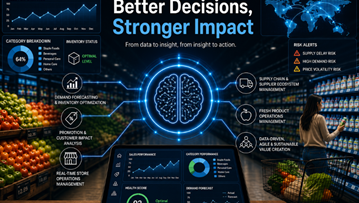
Where are we headed with AI-powered decision-making processes?

For many years, the retail industry has been generating increasingly rich volumes of data — not only for retailers themselves, but also for the entire value chain including suppliers, manufacturers, financial service providers, and cross-marketing partners. The primary goal has always been to better understand consumer behavior and improve the efficiency of interconnected operations.
With the acceleration of digitalization, retailers can now monitor both the consumer journey before and after purchase, as well as the entire lifecycle of a product from production to shelf, with unprecedented visibility. We are rapidly moving toward managing real-time store operations with a level of precision once only possible in online environments.
The vast amount of instant and enriched data generated through digitalization now enables operational decisions to be made in real time and based on actionable insights. Thanks to Generative AI, Agentic AI, and Decision Intelligence approaches, businesses are moving beyond simply asking “What happened?” to answering the far more valuable question: “What should we do next?”
Leading retailers and technology players have already been running pilot projects for years. However, while most initiatives until now have largely been experimental, 2026 will mark a turning point where AI projects begin delivering measurable business outcomes at scale. Businesses will increasingly prioritize projects that can quickly reduce costs, increase revenue, and deliver tangible operational impact.
Organizations will need to determine which areas to prioritize based on their operational maturity and technology infrastructure readiness. Within this transformation, five key domains stand out as having the highest potential for impact.
Operational Decision Orchestration and Inventory Management
In the near future, supermarket operations will no longer rely solely on demand forecasting. Retailers will need systems capable of simultaneously evaluating promotion effects, store-specific consumption patterns, supply disruptions, weather conditions, operational constraints, and competitor actions.
With next-generation Agentic AI approaches, systems will evolve beyond simply generating reports and forecasts. They will become intelligent operational structures capable of monitoring risks in real time and orchestrating action processes dynamically.
Potential out-of-stock situations, store-level operational issues, supply chain pressure created by promotions, shrinkage risks, and critical delivery delays will all be identified much earlier.
These systems will automatically guide relevant teams, generate alternative action recommendations, and dynamically re-plan processes when necessary. As a result, operations management will shift from static, historical-data-driven structures into continuously learning, prioritizing, and enterprise-wide coordination mechanisms.
In the new era, competitive advantage will not come merely from making better forecasts, but from building systems capable of evaluating operational realities holistically and enabling faster collaborative decision-making.
1. Promotion, Customer Engagement, and Decision Engines
Traditional one-size-fits-all campaign approaches are rapidly losing relevance in retail. Going forward, retailers will move beyond simple personalization systems toward intelligent decision engines capable of simultaneously evaluating customer behavior, store-level demand variations, stock availability, supply conditions, and commercial objectives.
With next-generation Agentic AI systems, retailers will be able to manage in real time which products should be recommended to which customers, which campaigns should be prioritized in specific stores, and where promotional intensity should be increased or reduced.
For example, systems may automatically reduce promotional pressure on products facing stock risks despite high demand, while simultaneously activating personalized campaigns for categories with excess inventory or high shrinkage risk.
As a result, campaign management will no longer be solely a marketing-driven process. Instead, it will evolve into an integrated decision structure where category management, supply chain operations, store execution, and customer experience are optimized together.
The real competitive differentiator in the coming years will not be the ability to generate more campaigns, but the ability to make dynamic, contextual, and operationally aligned decisions.
2. Real-Time Store Operations Management
One of the biggest competitive differentiators in future store operations will be how quickly problems can be identified and resolved. Shelf availability issues, pricing inconsistencies, operational bottlenecks, workforce planning problems, and in-store disruptions can quickly lead to revenue loss and deteriorating customer experience if detected too late.
Next-generation AI systems will transform store operations from structures that merely analyze historical data into intelligent systems capable of monitoring operational flows in real time and orchestrating coordination between processes.
These systems will detect shelf accessibility problems, pricing errors, service disruptions caused by high traffic, operational bottlenecks, and abnormal in-store situations much earlier.
More importantly, they will not only identify problems but also guide relevant teams, dynamically update operational priorities, and accelerate resolution processes. Store management will evolve from reactive operations toward more agile structures capable of continuously learning, proactively managing risks, and increasing operational responsiveness.
3. Supply Chain and Supplier Ecosystem Management
In the future, retail competition will no longer occur solely between retailers. The real differentiator will be how effectively retailers and suppliers can operate as an integrated ecosystem.
Promotion impacts, demand fluctuations, logistics disruptions, supply continuity challenges, and category-specific operational pressures will become too complex for any single party to manage independently.
AI-powered decision systems will enable retailers and suppliers to operate with shared data, coordinated workflows, and much earlier visibility into operational risks.
Systems will be capable of evaluating the supply chain impact of promotions in advance, detecting demand shifts earlier, and generating alternative operational scenarios in response to critical logistics or supply disruptions.
Agentic AI structures will evolve beyond analytics platforms into orchestration systems that activate relevant teams, dynamically reshape operational priorities, and improve cross-functional coordination.
As a result, collaboration between retailers and suppliers will become more predictive, synchronized, and proactive rather than reactive.
Especially in the FMCG sector, the ability to make shared decisions and jointly manage operations will become one of the most important sources of competitive advantage.
4. Dynamic Management of Fresh Product Operations
Fresh product operations will continue to be one of the most critical and complex management areas in retail. Beyond sales performance, retailers must simultaneously manage shelf life, shrinkage, production planning, workforce allocation, and sudden intraday consumption fluctuations.
Next-generation AI systems will move fresh product management beyond historical sales analysis. These systems will detect shrinkage risks, store-level consumption anomalies, production-planning mismatches, aging inventory, and operational quality risks much earlier.
More importantly, they will not simply identify problems but also generate dynamic action recommendations, update store and category priorities, and guide operational teams in real time.
Production, pricing, and product management processes will become significantly more agile and adaptive based on rapidly changing intraday consumer behavior.
As a result, fresh product operations will evolve from static planning models into continuously learning, self-optimizing, and operationally agile systems.
5. AI Projects Must Become Operational Transformation Projects
Next-generation AI initiatives should no longer be treated solely as technology projects. Unless operational workflows, organizational structures, and decision-making processes are redesigned accordingly, even the most successful technology implementations will have limited real-world impact.
This is why next-generation platforms are increasingly evolving into systems that integrate Generative AI with enterprise knowledge, process management, and operational actions.
At Obase, with our AIR (AI-Ready) platform, we aim to lead this transformation by embedding trusted, actionable decision-making capabilities directly into operational processes.
Making AI outputs an active component of decision-making processes will define short- and mid-term business success. Achieving this across all operations will require time, especially in areas such as data quality, process standardization, and organizational transformation. However, there are already many practical and scalable projects that organizations can implement step by step.
In the coming years, the companies that create the greatest competitive advantage will not be those with the most data, but those that can transform data into accurate, reliable, and rapid action.
-> Click to read the article on Retail Turkey.