The Key to Managing AI with Confidence: AI Governance
Organizations today collect unprecedented amounts of data. Yet one fundamental truth remains: most of that information is not what drives strategic decisions. One of the greatest challenges executives face today is identifying the insights that truly matter amid an ever-growing volume of data.
There is also a common misconception worth addressing. Innovation alone is no longer enough for an AI solution to deliver business value. It must also be strategic, aligned with business objectives, measurable, and governed. Otherwise, even the most advanced AI initiative can become an impressive technology investment without a clear direction or lasting impact.
I'd like to share an observation from my own experience. During presales engagements for enterprise data platform projects, I've met with dozens of organizations exploring AI initiatives. One pattern appears repeatedly: teams present technically impressive AI use cases, yet few can answer a simple question:
Projects that postpone governance often encounter legal, compliance, or risk management roadblocks just before production deployment. Asking these questions during the architecture and design phase is often the difference between a successful launch and months of unnecessary delays.
Why Does AI Governance Matter?
Organizations collect data with the goal of turning it into better decisions. You may have world-class AI models and cutting-edge technology, but without strong governance, those assets can quickly become business risks.
This is where AI Governance becomes essential.
AI Governance establishes the principles and processes that ensure AI systems—whether developed internally, purchased from vendors, or delivered to customers—are:
- Trustworthy
- Ethical
- Transparent
- Secure
- Compliant with applicable regulations
Simply put, AI Governance enables organizations to maximize the value of artificial intelligence while effectively managing ethical, operational, security, and regulatory risks.
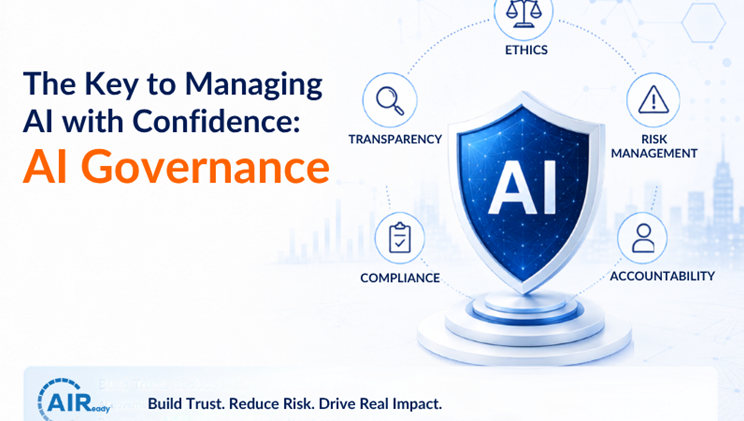
The Five Pillars of an Effective AI Governance Framework
A robust AI Governance framework is built upon five fundamental pillars:
1. Ethics
AI systems should be continuously evaluated for bias and fairness. Organizations need mechanisms to ensure that models do not generate discriminatory or unfair outcomes throughout their lifecycle.
2. Transparency
Every AI-driven decision should be explainable and traceable. Stakeholders must understand how conclusions are reached rather than treating AI as a "black box."
3. Risk Management
Potential risks should be identified early, assessed systematically, and mitigated proactively before they become operational or regulatory issues.
4. Compliance
AI systems must comply with applicable regulations, including frameworks such as the EU AI Act, GDPR, and local privacy laws such as Turkey's Personal Data Protection Law (KVKK).
5. Accountability
Organizations must clearly define ownership and responsibility for every AI-driven decision. Accountability ensures there is always a designated decision owner when issues arise.
While these five pillars appear straightforward on paper, the real challenge lies in operationalizing them across the organization.
In my experience, Accountability is the pillar most frequently overlooked. Ethics and transparency often receive significant attention in presentations and strategy documents. However, when organizations are asked, "Who approved this decision?", the answer is often unclear.
Without clearly defined ownership, even the most sophisticated governance framework remains little more than documentation rather than a practical operating model.
How to Put AI Governance into Practice
1. Establish an AI Ethics Committee
Create a clear review framework for evaluating the ethical implications of every AI initiative. Before a new project begins, the committee should ask questions such as: Who will be affected by this AI solution?, What data will be used?, Does the model introduce risks of bias or unfair outcomes?
The goal is to make ethical evaluation an ongoing discipline rather than a one-time checkpoint.
My recommendation is to avoid building a large, bureaucratic committee. Instead of a formal board that struggles to meet regularly, I prefer a lightweight review team of three or four people that becomes involved whenever a new AI use case is introduced. A data owner, the relevant business stakeholder, and a technical lead are often all that's needed. Heavy governance structures eventually become bottlenecks, while lean governance mechanisms tend to remain effective over time.
2. Build an AI Risk Assessment Framework
Develop a simple yet effective framework for assessing AI-related risks.
Classify AI applications into categories such as low, medium, and high risk, and clearly define for each category:
-
Governance requirements
-
Review procedures and review frequency
- Approval authorities
This transforms risk assessment from a theoretical document into a practical operational tool.
For example, a customer service chatbot may fall into a low-risk category, whereas an AI model used to approve loans or evaluate creditworthiness should be treated as a high-risk application requiring significantly stricter oversight.
3. Define Clear Accountability
One of the greatest weaknesses in AI projects emerges when no one can answer questions such as: "Who approved this decision?", "Who is responsible for monitoring the model?", "Who owns the outcome?"
To avoid this, organizations should:
-
Define ownership throughout the entire AI lifecycle—from development to deployment.
-
Establish formal approval workflows and governance checkpoints.
- Ensure that every AI initiative has a clearly designated business owner.
I cannot emphasize this enough: never allow an AI project to become ownerless.
In my experience, the most serious governance failures were rarely caused by technical issues. They escalated because, when something went wrong, no one could honestly say, "This was my responsibility."
4. Implement Transparency Protocols
Organizations should establish mechanisms for continuously tracking Training data, Decision logic, Model performance, Business outcomes, Transparency is not only essential for regulatory compliance—it is equally important for building trust within the organization. If an AI model cannot explain why it reached a particular conclusion, it becomes difficult for employees, executives, customers, and regulators to trust its recommendations.One important point deserves additional attention: explainability should not be designed exclusively for technical teams.
Showing engineering metrics to data scientists is not enough. Business users should also receive clear, business-friendly explanations that answer simple questions like:
"Why did the model recommend this offer for this customer?"
True AI governance exists only when both technical and business stakeholders understand how decisions are made.
Common AI Governance Mistakes to Avoid
Organizations frequently fall into the same traps when establishing AI governance frameworks.
Making Governance Too Complex
Overly bureaucratic governance structures discourage adoption and are often perceived as obstacles rather than enablers.
Excluding Key Stakeholders
AI governance is not solely the responsibility of technical teams. Legal, compliance, security, business leaders, and executive management all play essential roles.
Treating Governance as Static
AI technology evolves rapidly. Governance frameworks should evolve alongside it. Policies that remain unchanged quickly become outdated and ineffective.
Focusing on Rules Instead of Outcomes
Governance should never become a box-ticking exercise.
The objective is not simply to satisfy compliance requirements but to build AI systems that are trustworthy, responsible, and capable of delivering measurable business value.
Among these pitfalls, excessive complexity deserves particular attention.
Ironically, the least successful governance initiatives I've seen were often the ones with the largest documentation sets.
The most effective programs usually started with a simple one-page checklist containing only a handful of essential questions—and matured over time as the organization gained experience.
Governance Is the Compass for AI
AI systems are becoming increasingly autonomous. As their capabilities continue to evolve, governance frameworks must evolve alongside them.
A static policy document is no longer enough to govern a rapidly changing technology landscape. Organizations need governance models that are dynamic, adaptive, and embedded into everyday operations.
Ultimately, AI Governance is the foundation that enables organizations to unlock the full value of artificial intelligence safely, responsibly, and sustainably.
Companies that operationalize ethics, transparency, risk management, compliance, and accountability don't just reduce risk—they build trust, accelerate AI adoption, and create a lasting competitive advantage.
How AIR Delivers AI Governance by Design
At Obase AIReady-AIR, governance is not an afterthought or an additional control layer. It is embedded into the platform's architecture from the ground up—a true Governance by Design approach.
Each of the five governance pillars is translated into practical capabilities and built-in workflows, allowing organizations to adopt AI with confidence from day one rather than building governance frameworks from scratch.
Ethics: Trusted Decisions Through Semantic Intelligence
AIR's semantic layer and business rules library ensure that AI decisions are grounded in approved business definitions rather than the unpredictable output of a standalone large language model.
Built-in GuardRails filter prompts and responses to reduce harmful, biased, or inappropriate outputs before they reach end users.
By keeping business intelligence within the semantic layer—not inside the LLM—AIR delivers decisions that are explainable, consistent, and repeatable across the enterprise.
Transparency: Complete Traceability for Every Decision
AIR provides more than answers.
Every recommendation is accompanied by the underlying data sources, reasoning process, and root-cause analysis used to generate the response.
Every LLM interaction and tool execution is recorded in an immutable audit trail, allowing organizations to reconstruct exactly how a decision was made at any point in time.
Training data, business logic, and performance metrics remain continuously observable, supporting both operational visibility and regulatory readiness.
Risk Management: Governance Tailored to Business Risk
Not every AI interaction carries the same level of risk.
AIR differentiates governance workflows according to the business impact of each scenario. A low-risk informational query follows a different approval path than a high-impact recommendation capable of influencing strategic decisions.
Its LLM-agnostic architecture also enables organizations to run sensitive workloads entirely on-premises, ensuring that confidential data never leaves their own environment.
Built-in protection against prompt injection and manipulation adds another layer of defense against emerging AI security threats.
Compliance: Enterprise-Ready by Design
AIR is designed to support enterprise compliance from the outset.
The platform aligns with GDPR and Turkey's Personal Data Protection Law (KVKK), while offering deployment options that preserve data sovereignty through on-premises or customer-controlled environments.
Role-Based Access Control (RBAC) ensures users can access only the data relevant to their responsibilities.
Enterprise-grade authentication (SSO and MFA), AES-256 encryption, TLS 1.3 security, and a roadmap aligned with SOC 2 best practices help organizations meet evolving regulatory and security requirements.
Accountability: Every Decision Has an Owner
AIR closes the gap between insight and execution.
Tasks generated from AI recommendations are assigned to designated owners, tracked throughout execution, and monitored until completion.
This eliminates the common problem of valuable insights being discovered but never acted upon.
Comprehensive audit logs ensure that every decision can always be traced back to the responsible individual, the supporting data, and the reasoning behind it.
From AI Governance Principles to Business Reality
AIR transforms the principles of AI Governance into an operational enterprise platform.
Instead of building separate frameworks for ethics, transparency, risk management, compliance, and accountability, organizations can adopt a Decision Intelligence platform where these capabilities are built in from the very beginning.
The result is a faster path to enterprise AI adoption—one built on trust, governance, and measurable business impact.
Build Trust. Reduce Risk. Drive Real Impact.
Discover how AIReady enables enterprise AI with Governance by Design.
➡️ Meet AIReady