Semantics, Ontology, and Agentic AI: How Does Artificial Intelligence Search for Meaning?
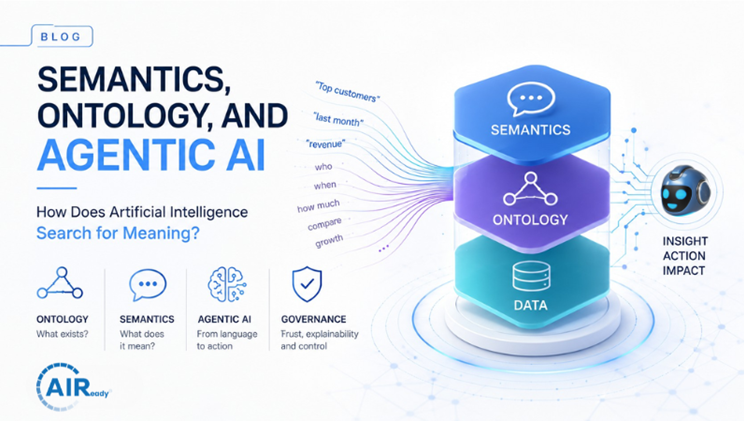
Two concepts that originated more than two thousand years ago now sit at the very heart of modern agentic AI architectures. In this article, we'll explore what semantics and ontology are, why they have become indispensable for enterprise AI agents, the technologies the industry has developed to bridge the gap between language and data, and how AIReady addresses this challenge through its semantic-first architecture.
According to MIT's 2025 report, 95% of enterprise GenAI pilot projects fail to generate measurable business impact (Challapally et al., 2025). Gartner predicts that more than 40% of Agentic AI initiatives will be abandoned before the end of 2027 (Gartner, 2025).
Surprisingly, these failures are rarely caused by the intelligence of the model itself. Instead, they occur because AI agents struggle to understand a company's data, business terminology, and operational context.
This invisible—but fundamental—problem has been discussed for over two millennia under two names: Ontology and Semantics.
This article explores why these concepts matter more than ever in the age of Agentic AI—and how OBASE AIReady - AIR bridges the gap between human language and enterprise data.
Ontology: The Question of "What Exists?"
At its core, what does a computer actually do? Surprisingly little. It manipulates symbols according to predefined rules. Zeros and ones, letters, numbers, and characters are continuously rearranged into new patterns—but the machine has no inherent understanding of what those symbols actually mean.
Imagine someone sorting letters from an unfamiliar alphabet simply by comparing their shapes. They may perform the task flawlessly without ever reading a single word. This illustrates one of artificial intelligence's oldest and deepest challenges. Computers excel at manipulating symbols. Humans understand meaning. Bridging the gap between symbols and meaning has always been one of AI's central problems.
For more than two thousand years, philosophers and scientists have approached this problem from two complementary perspectives: Ontology and Semantics. The word ontology originates from the Greek words on ("being") and logos ("knowledge" or "reason"), literally meaning the study of what exists. Aristotle was among the first thinkers to ask a remarkably simple question:
What exists, and how are those things related?
His answer laid the foundation for one of history's earliest classification systems. Although the question sounds philosophical, organizations answer it every day.
When a pharmacy categorizes medicines by active ingredient...
When a bank segments customers by risk profile...
When an insurance company organizes policies by coverage type...
Or when a database models customers, products, and orders as related entities...
They are all performing the same fundamental task:
They are defining what exists within a particular domain and how those entities relate to one another.
In computer science, this is precisely what an ontology is.
Tom Gruber's widely accepted definition describes an ontology as:
"An explicit specification of a conceptualization."
In other words, it is a machine-readable map of a business domain.
It defines:
- The entities that exist
- Their properties
- Their relationships
- The rules governing their interactions
An important shift occurs when ontology moves from philosophy into engineering.
For philosophers, ontology describes reality.
For engineers, ontology is designed.
There isn't one universal ontology.
There are countless domain-specific ontologies:
- Medical ontologies
- Retail ontologies
- Financial ontologies
- Insurance ontologies
- Customer data models
Each represents a different way of organizing reality.
That design choice is far from neutral.
Whenever a data engineer creates an entity called Customer, defines its attributes, or models relationships with orders, invoices, or products, they are making fundamental decisions about how the business world should be represented.
Every ontology carries an implicit worldview.
Those choices determine what an AI system will—and will not—be capable of understanding later.
Semantics: The Question of "What Does It Mean?"
If ontology asks "What exists?", semantics asks a different—but equally fundamental—question:
What does it mean?
The word semantics comes from the Greek word sēma, meaning sign. Today, semantics is broadly understood as the study of meaning.
One of its most important insights is especially relevant for AI: Syntax and meaning are not the same thing.
Noam Chomsky illustrated this beautifully with his famous sentence: "Colorless green ideas sleep furiously."
Grammatically, the sentence is perfectly valid. Semantically, it is meaningless. This perfectly captures the challenge facing AI systems.
Computers can manipulate language flawlessly without actually understanding it.
So where does meaning come from? Ludwig Wittgenstein argued that meaning does not reside inside words themselves.
Instead: The meaning of a word is its use. Consider the word game. You understand chess, football, and hide-and-seek are all games—not because they share one strict definition, but because you've repeatedly observed how the word is used in different contexts.
Meaning emerges from usage. This philosophical idea later became one of the foundations of modern language models.
Linguist John R. Firth famously summarized the principle in 1957: "You shall know a word by the company it keeps."
Modern Large Language Models are built upon exactly this idea.
Rather than memorizing dictionary definitions, they learn statistical relationships between words.
If a model repeatedly encounters tea alongside words like cup, brew, and sugar, while seeing it associated elsewhere with river, bridge, and flow, it gradually learns that the same word can carry multiple meanings depending on context. This remarkable capability explains why today's language models appear to understand language so naturally. Yet it also raises one of AI's biggest philosophical questions.
These systems learn entirely through statistical prediction. They never see an apple. They never touch it. They never taste it. Still, they can discuss apples with surprising fluency.
Do they truly understand? Or are they simply becoming extraordinarily good at predicting symbols?
This question remains one of the most active debates in contemporary AI research.
The Fundamental Gap: How Do Symbols Acquire Meaning?
Ontology asks: What exists?
Semantics asks: What do symbols refer to?
Together they lead to one profound question: How do formal symbols acquire meaning?
Philosopher John Searle illustrated the problem through his famous Chinese Room thought experiment. Imagine someone who speaks no Chinese sitting inside a room. By following an instruction manual, they receive Chinese questions and produce perfectly correct Chinese responses. To someone outside the room, it appears that the person understands Chinese. In reality, they are simply manipulating symbols according to rules. Nothing has actually been understood. Whether symbol manipulation alone can ever produce genuine understanding remains an open philosophical question.
Engineering, however, has learned something different. Instead of trying to solve the mystery of meaning itself, modern AI systems have learned to work with it. And that insight lies at the core of today's Agentic AI architectures.
Why Does This Matter for Agentic AI?
An AI agent does much more than generate text. It queries databases, invokes tools, orchestrates workflows, generates reports, and makes recommendations that influence real business decisions. To perform these actions reliably, an AI agent needs two essential capabilities.
First, it requires a trustworthy representation of the business domain—an ontology. The agent must understand what a customer is, how it relates to an order, what constitutes revenue, and which business rules apply in a given situation. Without this structured map of the enterprise, every action becomes uncertain. Ontology provides consistency, traceability, and governance.
Second, the agent must translate a user's often ambiguous natural language into that structured business model. Consider a request such as:
"Cancel the latest order from our biggest customer last month."
The agent needs to interpret concepts like "biggest," "last month," and "latest," and correctly map them to business entities, dates, and database records.This is where semantics comes into play.
Semantics enables AI to bridge the gap between human language and structured enterprise data. An effective AI agent requires both.
Ontology provides the map. Semantics provides the interpretation. Neither is sufficient on its own.
Two Approaches, One Challenge
Throughout the history of artificial intelligence, researchers have attempted to solve this problem from two very different directions.
The Symbolic AI Era
Early AI systems relied entirely on explicit rules.
Engineers manually described the world:
- A customer is defined as...
- An order belongs to...
- Under these conditions, perform this action...
These symbolic systems had one major strength:
Every decision was completely transparent. Their reasoning could be inspected step by step. However, they also suffered from significant limitations.
Handcrafted rules quickly became difficult to maintain as business complexity increased. More importantly, they struggled with the ambiguity and flexibility of natural language.
Beneath these practical challenges lay an even deeper issue known as the Symbol Grounding Problem, introduced by Stevan Harnad.
A symbolic AI system may process the symbol Customer perfectly, yet still have no intrinsic understanding of what that symbol represents in the real world.
Like Searle's Chinese Room, it manipulates symbols without understanding them.
The Rise of Large Language Models
Large Language Models took a radically different approach. Instead of manually encoding rules, they learn statistical patterns from billions of examples. This allows them to interpret natural language with remarkable flexibility.
Requests such as: "Show me our largest customer from last month." are often understood correctly without requiring predefined rules.
But this flexibility introduces a new challenge. Unlike symbolic systems, an LLM does not store knowledge in explicit business rules. Its understanding is distributed across billions of numerical parameters.
Consequently, answering questions like: "Why did the model reach this conclusion?" becomes considerably more difficult. The model behaves like a sophisticated—but largely opaque—black box.
The Best of Both Worlds
In simple terms: Symbolic AI is explainable but rigid. Large Language Models are flexible but difficult to govern. Modern Agentic AI seeks to combine the strengths of both. This emerging discipline is often referred to as Neuro-Symbolic AI. Rather than replacing symbolic reasoning with language models—or vice versa—it integrates them into a single architecture.
The fundamental design question becomes: Which knowledge should remain explicit and structured, and which should be left to the statistical reasoning capabilities of the language model?
The answer defines the architecture of modern enterprise AI systems.
Building Bridges Across the Gap
Instead of trying to solve the philosophical mystery of meaning once and for all, today's AI systems build practical bridges between structured knowledge and statistical language understanding. Every major enterprise AI technology falls somewhere along this spectrum.
At one end lies explicit knowledge. At the other lies statistical meaning. The most successful AI platforms combine both.
The Structure Side: Ontologies, Knowledge Graphs, and Semantic Layers
The Semantic Web community has spent decades developing standards for representing knowledge in machine-readable form.
Technologies such as:
- RDF
- OWL
- SPARQL
provide mature frameworks for modeling entities, relationships, and business rules.
One of their most practical implementations is the Knowledge Graph.
Knowledge graphs represent business entities as nodes and relationships as edges, enabling systems to reason about connections rather than isolated records. Platforms such as Neo4j have made this approach widely accessible at enterprise scale. However, many organizations need something even more practical. This is where the Semantic Layer becomes essential.
A semantic layer connects familiar business concepts—
- Revenue
- Active Customer
- Basket Size
- Average Order Value
- Credit Risk
- Claims Ratio
—to the underlying data warehouse, business rules, and calculation logic.
Solutions such as dbt Semantic Layer, Cube, and modern BI semantic models all follow this principle. In many ways, a semantic layer is simply an organization's ontology expressed in business language. For Agentic AI, this is transformational. Instead of guessing what "revenue" means, the model can rely on an explicit, governed business definition.
The Meaning Side: Embeddings and Fine-Tuning
At the opposite end of the spectrum are technologies that derive meaning statistically. Embeddings convert words, sentences, and documents into high-dimensional vectors. Concepts with similar meanings become mathematically close to one another.
Vector databases then make it possible to search by semantic similarity rather than exact keywords. This capability forms the foundation of modern Retrieval-Augmented Generation (RAG).
Another widely used technique is fine-tuning. Rather than relying solely on general-purpose language understanding, organizations retrain foundation models using industry-specific terminology and domain knowledge. The result is a model that becomes increasingly fluent in the language of a particular business or sector.
The Bridge: RAG, GraphRAG, Structured Outputs, and MCP
Several technologies now bridge structured knowledge and language models.
Retrieval-Augmented Generation (RAG) enriches an LLM with relevant information retrieved at query time instead of embedding all knowledge inside the model itself. Rather than relying entirely on memory, the model receives the documents, records, or schemas needed to answer a specific question. GraphRAG extends this concept even further.
Instead of retrieving isolated text passages, it provides structured context directly from a knowledge graph. This allows the model to reason not only about similar information but also about relationships between entities.
Another critical innovation is Structured Output and Function Calling. Rather than allowing the model to respond with unrestricted text, developers require it to produce outputs that conform to predefined schemas—often in JSON format. This transforms probabilistic language into deterministic structures that downstream systems can safely execute. The industry is now standardizing these interactions through initiatives such as Model Context Protocol (MCP), introduced by Anthropic in 2024.
MCP provides a common language that enables AI agents to connect consistently with enterprise tools, applications, and data sources.
No Single Technology Is Enough
Despite their impressive capabilities, none of these technologies solves the problem independently. RAG cannot define business meaning.
Structured outputs cannot generate knowledge on their own. Knowledge graphs cannot interpret ambiguous human language. Building an effective enterprise AI platform is therefore less about choosing one technology and more about combining them in the right proportions.
Modern AI architecture is, ultimately, the art of balancing structure and meaning.
How AIReady Solves the Challenge
Let's bring these concepts to life with a practical example. Imagine an organization that wants to keep its data entirely on-premises. The AI assistant must operate within the company's own infrastructure, without requiring a massive GPU cluster or sending sensitive data outside the organization.
At the same time, users expect a simple experience: they want to ask questions in natural language and receive accurate, trustworthy answers.
For example: "Who were my top three customers by revenue last month?"
Behind this seemingly simple question lies the very challenge we've been discussing throughout this article. "Top customers by revenue" represents a business metric. "Last month" defines a time period.
"Customer" refers to a specific business entity stored somewhere within the organization's data model. Every company structures these concepts differently. Table names, column names, relationships, and business terminology all vary.
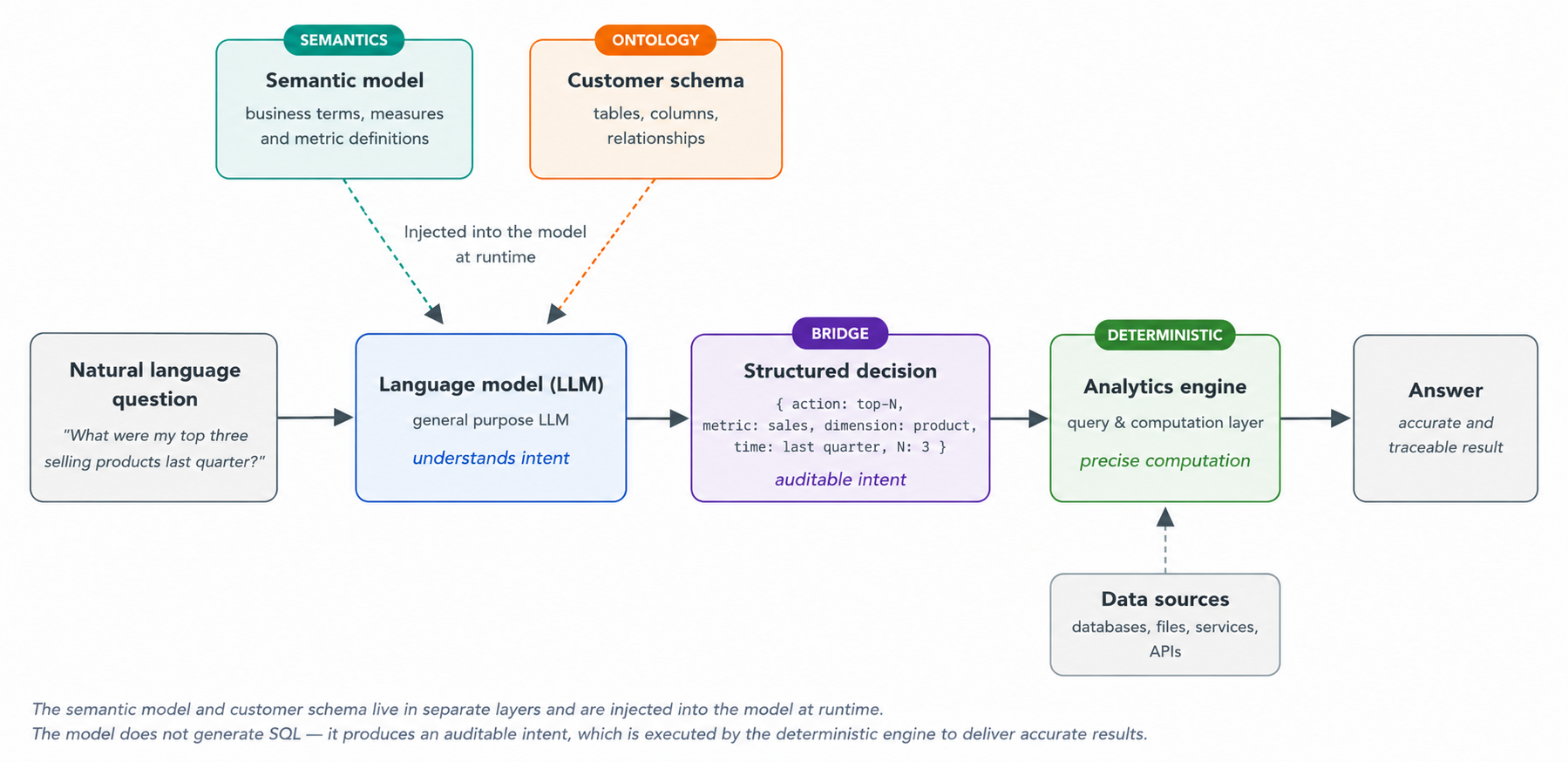
Rather than relying on a single "intelligent" model to solve everything, OBASE AIR distributes the responsibility across multiple architectural layers.
1. A Dedicated Semantic Layer
At the heart of AIReady is a general-purpose Large Language Model.
However, business concepts such as Revenue, Active Customer, Gross Margin, Last Month, or Year-over-Year Growth are not embedded inside the model itself.
Instead, these definitions live in an independent Semantic Layer.
Whenever a user submits a question, the relevant semantic context is injected into the model at runtime.
This provides three important advantages:
- Business definitions remain explicit and transparent.
- They can be updated without retraining the LLM.
- Organizations remain independent of any particular language model.
In other words, the language model can change without affecting the organization's business knowledge.
2. Customer-Specific Ontology at Runtime
Every enterprise has its own business vocabulary. Training a dedicated language model for every customer would be expensive, difficult to maintain, and ultimately unsustainable. OBASE AIR takes a different approach.
Instead of customizing the model, it injects each customer's enterprise ontology at runtime.
This ontology describes:
- available datasets,
- database schemas,
- business entities,
- relationships,
- and business terminology.
The language model remains general-purpose. The business context becomes customer-specific. This is where structured knowledge and natural language come together.
3. From Natural Language to a Structured Decision
Perhaps the most important architectural decision in AIReady is what it doesn't ask the language model to do.
Many AI assistants rely on Text-to-SQL, expecting the LLM to generate executable SQL directly from a user's question. While attractive in theory, this approach is inherently fragile. A single hallucinated table name or incorrect column reference can silently produce inaccurate business results.
Obase AIR avoids this risk. Instead of generating SQL immediately, the language model first translates the user's request into a structured business intent. For example: Operation: Top-N Metric: Revenue Dimension: Customer Time Period: Last Month N: 3
This structured decision becomes the bridge between natural language and enterprise analytics. Because it is explicit, it can be:
- validated,
- logged,
- audited,
- reviewed,
- or even confirmed with the user before execution.
At this point, ambiguous human language has been transformed into a governed, machine-readable representation.
4. Deterministic Analytics Perform the Calculation
Once the structured decision has been created, the language model's work is complete.
The actual calculation is performed by OBASE AIR's deterministic analytics engine.
Rather than relying on probabilistic text generation, the engine:
- queries enterprise data,
- combines multiple data sources,
- executes approved business calculations,
- applies business rules,
- and produces mathematically consistent results.
The accuracy of the answer is therefore based on deterministic computation—not on the model's prediction capabilities. The same architecture applies across industries. In retail: "Which products generated the highest revenue?"
In banking: "Which portfolio carries the highest credit risk?"
In insurance: "Which policy group has the highest claims ratio?"
The underlying workflow remains identical. Only the enterprise ontology and semantic model change.
One Architecture, Three Business Benefits
The entire workflow can be summarized as follows:
Natural Language → Semantic Layer → Enterprise Ontology → Foundation Model → Structured Decision → Deterministic Analytics Engine → Trusted Answer
This architecture delivers three tangible business benefits.
Accuracy
Business results are produced through deterministic analytics rather than language model predictions.
Explainability
Every recommendation is backed by a structured decision that can be inspected, validated, and audited.
Organizations can always answer an essential governance question:
"How did the AI arrive at this conclusion?"
Cost Efficiency
Because computationally intensive analytical work is handled by deterministic components, the language model focuses on interpretation rather than calculation.
This allows organizations to achieve enterprise-grade performance using smaller, more efficient models.
Flexibility by Design
Perhaps the most important aspect of OBASE AIR is that it is not built around a single architectural recipe. Every organization has different security requirements, data architectures, governance policies, and AI maturity.
OBASE AIR adapts accordingly. Organizations with strict data sovereignty requirements can deploy the platform entirely on-premises. Others may choose to integrate with leading cloud-based foundation models. Some implementations rely heavily on Retrieval-Augmented Generation (RAG). Others benefit from richer semantic models or enterprise knowledge graphs.
In certain scenarios, sophisticated agent workflows provide the greatest value; in others, lightweight tool orchestration is sufficient. Rather than enforcing a single approach, AIReady allows organizations to determine the right balance between ontology, semantics, retrieval, and language models for each business scenario. Because every enterprise represents a different world, every AI architecture requires its own bridge between language and data.
Final Thoughts
At the beginning of this article, we imagined someone sorting unfamiliar symbols without understanding a single word. In many ways, the history of artificial intelligence has been an attempt to teach machines how to move beyond symbols and toward meaning. Perhaps the real breakthrough is recognizing that no single component has to do everything.
Language models excel at interpreting natural language.
Semantic models define business meaning.
Ontologies organize enterprise knowledge.
Deterministic analytics ensure precision.
Structured decisions connect them all.
OBASE AIR is built around exactly this division of responsibilities. The philosophical question that has challenged thinkers for more than two thousand years—How does form become meaning? —may remain unanswered. From an engineering perspective, however, we have learned something equally valuable: Rather than solving the mystery itself, we can build systems that work with it—reliably, transparently, and at enterprise scale.
Ready to Build AI That Truly Understands Your Business?
Discover how OBASE AIR combines semantic intelligence, enterprise ontologies, and deterministic analytics to deliver trustworthy, explainable, and business-ready AI.
Get in touch with our team to see OBASE AIR in action.