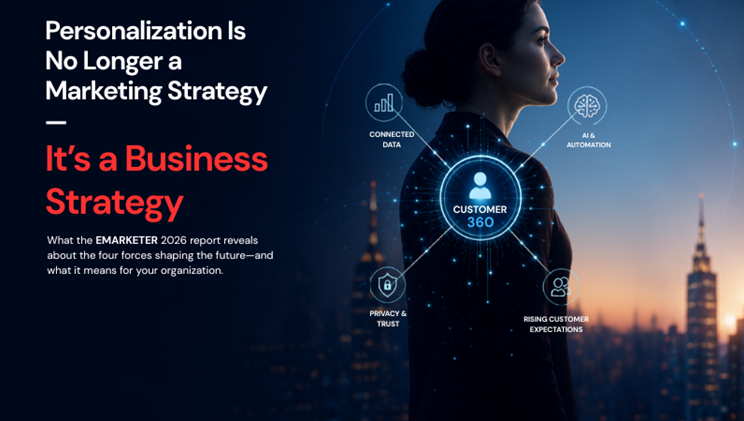
Personalization Is No Longer a Marketing Strategy—It's a Business Strategy
For years, personalization has been defined as delivering the right message to the right customer at the right time.
That definition is no longer enough.
EMARKETER's June 2026 report, "The 4 Forces Shaping Personalization in 2026" argues that personalization is evolving from a marketing tactic into an enterprise-wide operating model. As customer expectations continue to rise, many organizations are discovering that their technology, data, and operating models are struggling to keep pace.
So, what is preventing organizations from delivering truly personalized experiences? And why has Customer 360 become the foundation for the next generation of AI-powered business?
1. The Challenge Isn't Data Scarcity—It's Data Fragmentation
Most organizations already possess vast amounts of customer data.
The problem is that this data remains scattered across disconnected systems.
According to EMARKETER, 78% of marketers say they cannot produce personalized content at the scale they need, while 65% struggle to deliver timely personalized experiences across customer segments. The underlying issue isn't a lack of data—it's the inability to unify customer information and turn it into actionable intelligence.
Today's competitive challenge is no longer Big Data.
It is Connected Data.
2. AI Has Raised the Standard for Personalization
Generative AI has dramatically reduced the cost and effort required to create content.
Ironically, it has also increased the risk of creating content that feels generic.
As EMARKETER highlights, AI makes content creation easier—but it does not automatically make customer experiences more relevant. Relevance still depends on connected customer data, business context, and effective governance.
The competitive advantage is no longer producing more content.
It is producing more meaningful experiences.
3. Customer 360 Is the Foundation of Modern Personalization
True personalization requires organizations to understand customers beyond isolated interactions.
It means bringing together:
- Purchase history
- Digital behavior
- Loyalty engagement
- Marketing interactions
- In-store and online activities
- Customer Lifetime Value (LTV)
- Preferences and intent
into a single, trusted customer profile.
This is the essence of Customer 360.
Organizations must move beyond segmentation and begin understanding customer context in real time.
4. AI Agents Are Redefining Customer Engagement
Another important finding from the EMARKETER report is the rapid adoption of AI-powered recommendation experiences.
The report forecasts that more than 47 million US adults will use generative AI for personalized product recommendations in 2026, with continued growth expected over the coming years.
This shift will fundamentally reshape:
- CRM strategies
- Loyalty programs
- Product discovery
- Commerce experiences
- Customer engagement models
Customers will increasingly interact not only with brands—but with AI agents acting on behalf of brands.
From Customer 360 to Decision Intelligence
Understanding customers is no longer enough.
Organizations must also make better decisions using that understanding.
This is where Customer 360 evolves into Decision Intelligence.
Obase CRM Suite brings together customer data from across the enterprise to create a unified Customer 360 foundation. AIReady Decision Intelligence Platform builds on that foundation by combining customer intelligence with business context, semantic understanding, and AI-powered decision support.
The result is not simply better marketing.
It is smarter decisions across marketing, sales, customer service, loyalty, merchandising, and operations.
Conclusion
The future of personalization is not about sending more personalized campaigns.
Nor is it about collecting more customer data.
The organizations that will lead in the AI era will be those that:
- Build a trusted Customer 360 foundation
- Connect customer intelligence with business context
- Enable real-time, AI-powered decision making
- Deliver consistent, relevant experiences across every touchpoint
Because the next competitive advantage will not belong to companies with the most data.
It will belong to organizations that understand their customers better—and transform that understanding into better business decisions.
Read the full report.